Canadian Intellectual Property Office (CIPO) has laid out a five‑year business strategy that directly affects how patents will be examined. For inventors, companies, and IP professionals, the plan signals CIPO’s intent to change. However, we will see if there are meaningful changes in pendency, quality, digital tools, and policy.
Background
CIPO is the federal agency responsible for administering Canada’s intellectual property (IP) system, including patents, trademarks, copyrights, and industrial designs. They are based in Gatineau, QC, CA and have delivered online services for decades.
They periodically issue strategic plans. We read them so you don’t have to.
Proposed Changes
Here is an overview of the proposed changes.
1. Faster, More Efficient Patent Examination
CIPO’s plan places heavy emphasis on reducing pendency and improving examination throughput. Two initiatives matter most to patent applicants:
- Optimizing examination capacity and pendency. CIPO plans workflow optimization, automation of routine steps, and improved case management to reach internationally competitive timelines. This is a direct response to longstanding concerns about slow examination.
- Strengthening examiner efficiency and productivity. Examiners will receive enhanced training and new digital tools, including AI‑assisted examination support, to improve consistency and speed.
The hope is you get shorter waits, more predictable timelines, and more consistent examination outcomes. However, if speed is important to you, then remember that you can request examinations on filing in Canada, and not wait four (4) years. As we previously noted, it takes seven years to obtain a patent in Canada.
We hope the AI tools, if implemented, help the examiners and aren’t a burden. We note the AI examination programs of the USPTO have been a failure.

2. Digital Modernization of Patent Systems
CIPO has already replaced its legacy patent IT system, and the strategy confirms ongoing optimization based on user feedback and technological advances. The transition to the Next Generation Patents started in 2024 and was a disaster. We are still dealing with unresolved issues and backlogs.
Others agree with Perpetual’s assessment. For example, Richard Mar, a friend of ours, lawyer, and patent agent, publicly wrote about the number of errors in the new system one year after implementation. Charles Boulakia, a Canadian patent agent, regularly analyzed and reported on CIPO operational statistics with a lens to the backlogs and processing wait times caused by CIPO changes. Two years after implementation, backlogs remained.
The office hopes to keep improving with a “digital‑first” approach, making patent filing and management more transparent and accessible. Without mentioning their technical debt, CIPO promises improvements including:
- More reliable and efficient examiner tools
- Better data integrity
- Reduced downtime
- Enhanced online tracking and client-facing features
Given CIPO’s track record, be prepared for delays, disruptions, and lost patent rights. All we can say is be prepared for the unexpected and regularly check your applications.

3. Legislative and Regulatory Reform Affecting Patents
CIPO plans to modernize IP administration through targeted reforms. Patent‑relevant elements include:
- Streamlining processes and reducing red tape. This includes operational innovations such as flexible Patent Appeal Board panel composition.
- Developing a policy framework for AI in examination. As AI becomes integrated into search, analytics, and workflow tools, CIPO aims to ensure transparency, accountability, and alignment with international norms.
- Evidence‑based policy development. Research into how SMEs use IP will inform reforms that make patent protection more accessible and relevant to Canadian businesses.
We note that PAB has not issued a decision in ten months since 2025-10-14. The mean time from final action to a Commissioner’s Decision is 3.5 years. Looking at the last 20 decisions, the median time was 5.8 years.
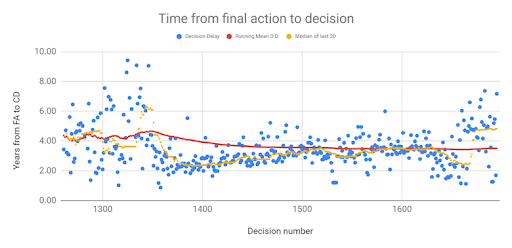
PAB has used two-member panels instead of three a few times since 2010. They tried one-member panels from 2020 – 2022, 2024, and 2025 with no indication there was an improvement in time to a decision. Regardless, a vague statement to continue with a 15-year-old pilot is hardly innovation.
We are unclear on what evidence gathering CIPO will do. For example, they have no data on how many small entities use the industrial design system at present, so they can’t say anything about the effect of a new small entity rate for this IP type. Also, we suspect they would be entirely inwardly focused, looking at their own data instead of answering questions like: how many Canadian applicants use the US provisional patent application system?
As for the use of AI, we hope the tools are useful and save examiners from busywork.
4. Enhanced Access to Patent Protection
CIPO’s strategy includes several initiatives that directly impact patent accessibility:
- Increasing affordability and accessibility of IP services. The office aims to do a fee review and reduce administrative burdens to make IP rights attainable for SMEs and early‑stage innovators.
- Provisional patent applications. CIPO is exploring provisional patents to enhance flexibility and lower barriers for innovators seeking early protection for their intellectual property.
- Bifurcated accelerated examination. There will be two accelerated pathways. A first, fee-based option for all and a second for government priority areas such as clean tech, AI, quantum, and advanced manufacturing.
- Expanding outreach and education. The office is expanding outreach and education to create awareness of IP. They want to help inventors and startups understand when and how to pursue patents.
The office is being opaque with a plan to “modernize its fee structure”. CIPO last ran a fee review in 2022 and implemented a 25% fee increase in 2024. It is unclear whether they are now admitting they made mistakes, or simply want to increase fees over inflation.
We note that until CIPO can issue a filing certificate in a second, as the USPTO can, any investment in a system for provisional patent applications is a waste of money that CIPO could spend more effectively elsewhere. The current service standard is 36 weeks, and a typical time is 15 days or 1.3 million seconds. To be effective, CIPO would literally need to be a million times faster.
To make any provisional system useful, CIPO would need to start automatically uploading the provisional applications to WIPO’s Digital Access Service (DAS) and end its Kafkaesque practice of forcing applicants to make a separate DAS upload request. (CIPO briefly included upload requests as part of the filing system in 2022 — 2024, but this appears to have gone away with the Next Generation Patent system.)
The change to accelerated examination is one of the most significant patent‑specific commitments in the plan, helping innovators in fast‑moving sectors. That said, Perpetual knows of a few ways you can accelerate examination of your patent applications.
Some of these changes will require legislative changes. The Patent Act has been changed 11 times in 25 years, but recently the changes have been part of large omnibus bills, not a specific amendment around a specific purpose. We shall see when in the 2026 – 2031 window the changes are made.
CIPO spending money on outreach would duplicate the work of other agencies. ISED, through IRAP’s IP Assist and ElevateIP, is doing a fantastic job. If they want to support these efforts, that would be helpful. Or they can bring an examiner perspective to education. We are also a fan of IP Voices by CIPO which is a great resource. However, given the grand plans for IP Central, a “digital hub designed to empower Canadian innovators, entrepreneurs, researchers and SMEs with trusted, accessible IP knowledge”, we urge restraint. CIPO could focus on curation and publication rather than content creation.
5. Improved Access to Patent Data
CIPO recognizes that patent data is a strategic asset for research, competitive intelligence, and commercialization. The strategy includes:
- Enhanced access to patent data and analytics
- Better integration of patent information into IP Central
- Support for researchers and policymakers using patent datasets
CIPO’s patent search functions have not changed much in 25 years. We welcome CIPO creating an API for meaningful analytics.
CIPO also has focused on data that shows it meets service standards and not on data that helps with analytics. Better data would help CIPO, the Government of Canada, and the public.

Conclusion
CIPO’s 2026–2031 Business Strategy makes promises of the office being faster, more predictable, and more digital. When we see results, we post again.
If you would like to discuss protecting your invention with a patent application, please contact us.