Plant breeders’ rights are a quiet corner of Canadian intellectual property. For decades, the Plant Breeders’ Rights Act (PBRA) functioned more like a registration system than a source of litigation. Breeders registered new varieties, seed companies licensed them, farmers bought certified seed, and the system largely ran without concrete examples of what could happen to infringers.
But as we explored in our earlier post, A Cherry on Top, studying other IP rights can help IP managers understand the issues in general. IP systems often evolve in long, slow arcs. They build infrastructure, norms, and expectations and then, seemingly overnight, a single case changes the guidelines for companies. For plant breeders’ rights, that moment arrived in Alliance Seed Corp v Fournier, 2026 SKKB 5, the first Canadian decision to award damages for infringement under the PBRA.
A History of Plant Breeders’ Rights in Canada
The history of this IP right, which lasts between 20 and 25 years, has a few events and stages. It provides protection for a cultivar – a clearly distinguishable group of plants that retains its unique characteristics when reproduced through controlled methods (such as cuttings, grafting, or controlled seed production).
1990: Canada Enacts the PBRA
Canada introduced plant breeders’ rights to align with international standards and encourage domestic breeding innovation. The PBRA granted breeders exclusive rights over propagating material of new varieties – an IP right similar in spirit to patents, but tailored to agriculture.
1990 – 2015: A System Focused on Registration, Not Litigation
For 25 years, applicants could apply to the Plant Breeders’ Rights Office run by the CFIA. The application volumes were far less than patents and trademarks, less than design rights, but more that integrated circuit protection. The PBRO received 337 applications in 2020, 356 applications in 2021 (a 5% increase), and 380 applications in 2022. No Canadian court issued a damages award for infringement.
2015: Modernization Under UPOV 1991
Canada amended the PBRA to meet the standards in International Union for the Protection of New Varieties of Plants (UPOV) 1991, expanding:
- the scope of exclusive rights,
- enforcement mechanisms, and
- the commercial value of protected varieties.
Still, no damages cases reached the courts.
2026: The First Damages Award
Alliance Seed Corp v Fournier finally forced the PBRA into the courtroom spotlight.
Alliance Seed Corp v Fournier
The dispute involved CDC Verona, a durum wheat variety developed by the University of Saskatchewan’s Crop Development Centre. Alliance Seed Corporation held exclusive sublicensing rights.
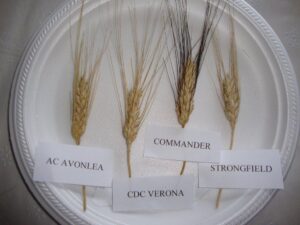
This variety matures four (4) days and about 4% sooner than “Commander”, a well-known variety. Speedier crops can help with both heat and rain events.
Farmer Guy Fournier allegedly sold Verona seed without authorization between 2013 and 2016. Under the PBRA, farmers are allowed to save and reuse protected seeds for their own subsequent crops, but they are strictly prohibited from selling or even advertising those seeds to other farmers. Mr, Fournier did not file a defence, ignored disclosure obligations, and was held in contempt and liable for infringement.
Justice Robertson’s decision from the Court of King’s Bench is significant for five reasons.
1. The First Damages Award Under the PBRA
For the first time in the PBRA’s 35‑year history, a Canadian court awarded damages for infringement. This alone is historic: it confirms that plant breeders’ rights are not merely administrative registrations — they are enforceable IP rights with real financial consequences.
2. Patent‑Law Principles Guide Damages
Because the PBRA contains limited guidance on quantifying damages, the court turned to patent‑law principles. This is a crucial development providing a roadmap for future cases.
3. General Damages of $1.18 Million
With no reliable records from the defendant, the court estimated quantities based on methods from patent law and awarded $1,175,862.56 in general damages.
The implication is that poor record‑keeping will not shield infringers. Courts will estimate rather than under‑compensate. However, note how Mr. Fournier was viewed as “an unsophisticated farmer [who] should not be punished for failing to keep accurate records.” If your business infringes an IP right, you might be punished for bad records.
4. Punitive Damages for Litigation Misconduct
Fournier’s evasiveness and refusal to produce documents led to two penalties. The first was $10,000 for contempt, and the second $50,000 in punitive damages. Alliance requested aggravated or punitive damages for $100,000.00. The judge cited the fact “the infringement continued over four years [and] Mr. Fournier was uncooperative in the litigation process”.
This was very different from the Schmeiser case where Percy Schmeiser used patented canola seeds without dealing with Monsanto. And when sued, raised genuine defences in fact and law.
5. Permanent Injunctions Are Not Automatic
Despite proven infringement, the court declined to issue a permanent injunction. This is a reminder that PBRA remedies are discretionary, not guaranteed, and must be justified on the facts. The judge agreed the “request for a permanent injunction” was “justified by the repeated past breaches” but declined to grant this remedy as there was “no evidence of continuing breach or likely future breach.”

Why This Case Matters or Not
This case may or may not matter to you.
Why This Case Matters
To most readers, this case will not matter. However, for academic and industrial breeders, seed companies, and farmers, Alliance Seed is more than a damages award. It is a turning point that:
- Provides guidance on the enforceability of rights under PBRA
- Provides the first judicial methodology for calculating damages
- Signals that courts will borrow from patent law when needed
- Warns that injunctions require evidence, not assumptions
Why This Case Might Not Matter
It is entirely possible that litigation will be the exception, not the norm.
What Can You Learn From This Case as an IP Manager.
Again, as we noted in A Cherry on Top, sometimes reading about other IP rights can remind one of things that are not top of mind. For example, in both cases, records were relevant. In the Staccato cherry case (Her Majesty the Queen in Right of Canada v. Van Well Nursery, Inc., 649 F. Supp. 3d 1055 (E.D. Wash. 2022)) having records saved the plant patent. In Alliance Seed, the lack of records led to contempt charges and fines.
A licensee can sue. This is a fairly common principle in IP law and a consideration when handing out licenses.
Conclusion
If you would like to discuss protecting your invention with a patent application, please contact us. If your firm deals in plant breeder’s rights please let us know in case we have a future referral for you.