Patenting the invention is usually the better route, as it gives broader rights that cover your product and any other products that use the same inventive feature. Your claims ideally do cover systems, devices, components, and methods that appear in many products. Conversely, a product patent or patenting your product, simply means claims directed to the finished item as you intend to market it, which is a narrower claim.
Background
People often call us for a free consultation on patenting something. Often, they ask to patent their product. We ask if they are open to patenting an invention. Some people make the conceptual leap and discuss the matter with us. Others get stuck on their narrow goal. Speaking to in-house IP managers, we hear similar stories.
Patent for a Product
The heart of a patent is the claims. If granted, these claims are what prevent others from making, using, or selling the subject matter defined by the claims. So if your claims are directed to a finished article of manufacture (c.f., method, device, or composition) your patent rights are for the specific product as claimed. While useful in some cases, these claims would be seen as narrow.
These comments apply when the product isn’t an article of manufacture. In software, a claim on the product would be a minimum viable product, as claimed, as a system, device, computer-readable medium including processor-executable instructions, or a method. If your product is a service, the claim could be a method describing your service and only your service.
Patent for an Invention
If you focus your patent on your invention, showing various embodiments, and claiming your invention, then you are likely claiming the use in many products. This is simply broader. Enforcement covers any product that practices the claimed invention. With some exceptions, we generally advise patenting a component or feature rather than the entire product.
Your invention can be claimed as a part, a set of parts in a kit or in a device or a system that includes one or more parts. In software, a claim on the invention reads closer to the product claims than they do in other fields. Your first claim is likely a claim on a feature of the product as embodied in a system, device, computer-readable medium including processor-executable instructions, or method. If this seems unfair, it might be, but it is how patent practice has developed.
Comparison Table
| Criterion | Product patent | Component or feature patent |
| Scope | Covers the claimed finished item only. | Can cover the inventive part, method, or material and thus reach multiple products. |
| Enforceability | Straightforward if competitors copy the whole product. | Stops competitors from using the inventive idea even in different products. |
| Drafting complexity | Simpler claims, but may be easy to design around. | Requires careful claim drafting; more legal and technical work. |
| Cost | Filing one product claim set can be cheaper initially. | May cost more to draft multiple claim sets (e.g., component, method, kit), but gives broader protection and licensing value. |
| Best when | The whole product is novel and unlikely to be modularized. | The inventive element is reusable, licensable, or can appear in many products. |
Which is Better in Practice?
It depends. Narrow product claims are cheaper but easier to design around. Sometimes a narrow patent, patenting your product, is part of your strategy. Broad invention claims cost more to prepare and prosecute, but give stronger market control and licensing potential. Plus, you can add a fallback dependent claim for the product.
- If the invention is for a part of a product, that part (e.g., component, device, method) could be reused elsewhere. That gives your patent broader commercial leverage to protect your product, increase licensing potential, and block competitors across product lines.
- If the novelty is only the final product’s overall configuration and it is unlikely others will piece out or reuse parts, then product-directed claims may suffice.

Examples of When a Patent for an Invention was Better
The invention can be far removed from the product or its benefit.
- You would never confuse a vehicle for the Moylan arrow. Named for James Moylan (1945 – 2025), a longtime Ford engineer, a small arrow on the fuel gauge indicates which side of the vehicle the fuel door is located. This small feature was first implemented in the 1989 Ford Escort and has since become a standard in modern vehicles, helping drivers avoid confusion at gas stations.
- Ernest L. Ransome was an engineer who built many structures using reinforced concrete – a material he did not invent – but he invented, patented, and used twisted steel bars that bound to the cementitious concrete. His products were buildings and bridges. His invention was much more subtle and valuable.
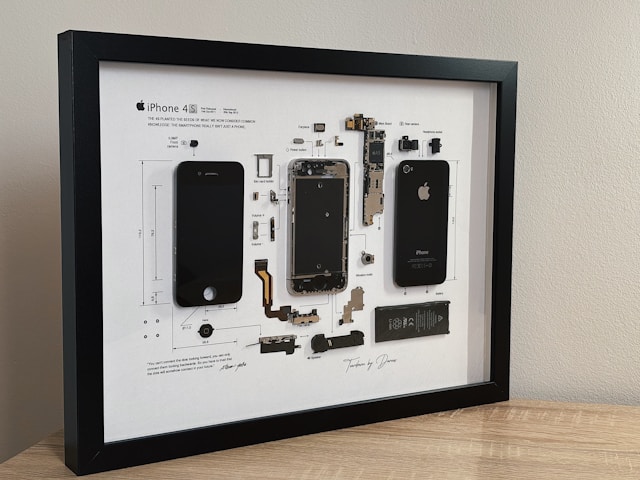
- A product like the iPhone doesn’t have just one patent because a phone has many parts each of which could include many inventions.

Practical Next Steps
- Do a patentability search to reduce wasted costs.
- Decide claim strategy. Pick what you are focusing on. Draft independent claims to the inventive feature plus dependent claims.
- File a provisional or priority application quickly to secure a date, then make your national filings.
Conclusion
If you would like to discuss protecting your invention with a patent application, please contact us.